The most valuable thing your child gains from training is not a single technique, but a set of life skills that show up everywhere else.
Parents often start looking into Young Brazilian Jiu-Jitsu because they want something practical: confidence, discipline, safe self-defense, better behavior at school, a healthier outlet for energy. We get it. Orlando is full of busy schedules, busy roads, busy minds, and kids feel that pace too.
What surprises many families is how quickly the benefits show up in everyday life. Our kids do not just learn how to grapple. Through age-appropriate drills, structured games, and coached partner practice, kids build habits that carry over to homework, friendships, sports, and the moments when emotions run hot.
Below are five essential skills young practitioners develop through consistent training, and how we teach them in a way that emphasizes discipline over aggression.
Why these skills matter in Young Brazilian Jiu-Jitsu
Young Brazilian Jiu-Jitsu is a problem-solving martial art. Kids learn to pay attention to details, read body position, and make decisions under a little pressure. When training is coached properly, that pressure is controlled and safe, but still real enough to help kids grow.
Our goal is to give your child a structured environment where effort matters, respect is non-negotiable, and progress is visible. Kids get to practice being calm, coachable, and persistent, even when something feels difficult at first. That combination is powerful, and it is exactly why families keep showing up week after week.
Skill 1: Focus and concentration
How we build focus in class
Focus is not just “being quiet” or staring at an instructor. In grappling, focus is active. Kids must watch, listen, try, adjust, and try again. That is true in technique practice, and it is especially true during rolling, which is controlled sparring where kids apply what they have learned with a partner.
We develop concentration through short, clear teaching segments followed by repetition. Kids learn a movement, drill it with a partner, and get quick corrections. Over time, that pattern trains attention like a muscle. Kids begin to understand that details matter: where hands go, how hips move, what happens if posture breaks.
Why it shows up at school
When a child practices focusing on one task while another person is moving and reacting, sitting down to focus on math or reading starts to feel less overwhelming. We also see that kids who struggle with staying on task often do better when expectations are simple and consistent. On the mats, the task is clear: listen, try, be safe, and keep going.
Skill 2: Emotional regulation (managing emotions)
Pressure without panic
In Young Brazilian Jiu-Jitsu, kids experience small doses of pressure in a supervised setting. Maybe a partner gets a strong position. Maybe a drill feels frustrating. Maybe a child loses a scramble and wants to quit for a second. Those moments are not problems. Those moments are the lesson.
We coach kids to breathe, reset, and respond instead of reacting. They learn that feeling nervous or frustrated is normal, and that they can still make good choices while feeling that way. This is emotional regulation in action, not a lecture.
Tapping teaches self-advocacy
One of the healthiest habits we teach is tapping. If something is uncomfortable or a position is stuck, kids tap to signal “stop,” and the partner immediately releases. That simple rule builds trust and body awareness. It also teaches kids that speaking up is allowed and respected, which is a big deal for confidence.
The confidence effect
When kids realize they can stay calm under pressure, confidence changes. It becomes quieter and more stable. It is less about showing off and more about knowing, “I can handle this.” We want that feeling to follow your child into school presentations, team tryouts, and social situations.
Skill 3: Resilience in adversity
Learning to be uncomfortable, safely
Resilience is built in the small moments. A drill is tiring. A position is tough. A technique takes a few weeks to click. Kids learn that discomfort does not mean danger, and difficulty does not mean failure.
We normalize the idea that progress is uneven. Some days feel great. Some days feel clumsy. Both are part of training. As long as your child is safe and respectful, we want your child to keep showing up and putting in honest effort.
Losing becomes information, not a label
In rolling, a child might get pinned, swept, or submitted. We treat that as feedback. What happened right before the position changed. Where was posture lost. What could be done differently next time.
This mindset is a resilience skill your child can use anywhere:
- A low test score becomes a study plan, not a permanent identity
- A tough social moment becomes a chance to practice communication
- A mistake in another sport becomes a correction, not a meltdown
Skill 4: Physical coordination and balance
Why grappling develops real athleticism
Coordination in Brazilian Jiu-Jitsu is not just running fast or jumping high. It is proprioception, the ability to feel where your body is in space. Kids learn to move hips, legs, and hands in sync while maintaining balance, sometimes while another person is trying to off-balance them.
Our drills build a foundation of movement quality: base, posture, grip control, safe falling, and smooth transitions. Even when we keep things playful, the athletic benefit is real.
What this looks like for kids
Over time, we often see improvements in:
- Balance when changing directions, stepping, or pivoting
- Body control in close contact without panic or flailing
- Spatial awareness, especially during partner drills
- Core strength and endurance that develops naturally through movement
For many kids, this also lowers the risk of getting hurt in everyday play because they learn how to stabilize and how to land safely.
Skill 5: Conflict resolution through respect and teamwork
The culture matters as much as the technique
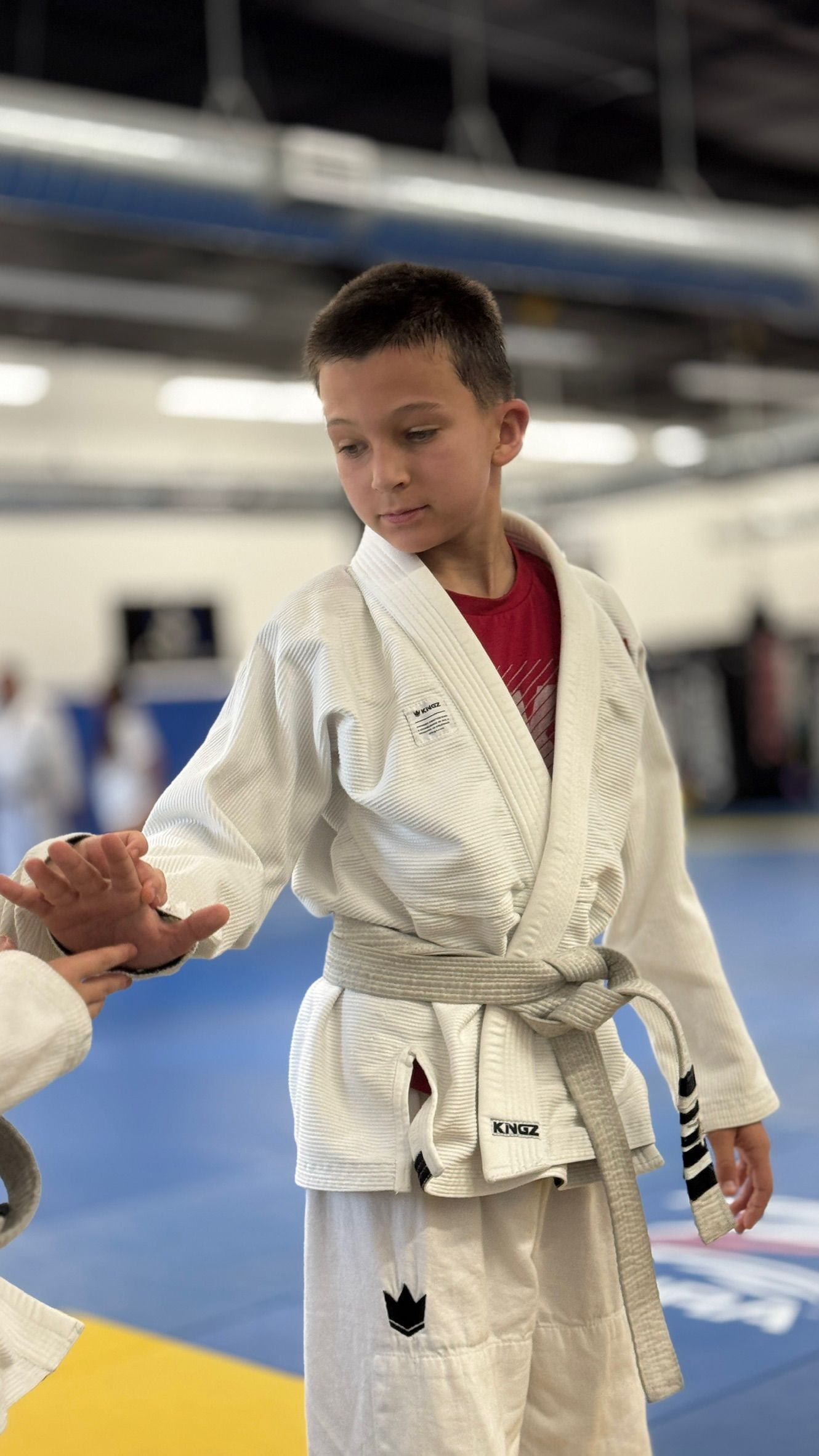
Kids do not learn well in an environment fueled by ego. Our classes are structured to reward respect, listening, and partner care. Every drill requires cooperation. Every round requires control. Every high-five and reset is part of teaching kids how to handle conflict without escalating it.
In Young Brazilian Jiu-Jitsu, a child learns that “winning” is not the point. The point is learning, staying safe, and helping partners improve too. That is teamwork, even in a one-on-one sport.
Practical, non-violent assertiveness
We teach kids to be assertive without being aggressive. That means using a strong voice, clear boundaries, and calm posture. It also means understanding options. Sometimes the right choice is to walk away. Sometimes it is to get an adult. Sometimes it is to protect yourself and create space.
Because Brazilian Jiu-Jitsu emphasizes leverage and technique, kids also learn that size differences do not have to decide the outcome of a situation. That alone can reduce anxiety for smaller kids, especially in messy playground dynamics.
What parents in Orlando usually want to know
We hear a few questions again and again from families interested in Young Brazilian Jiu-Jitsu in Orlando FL, so here are straightforward answers based on how we run class.
Is BJJ safe for young kids?
Yes, when it is taught with age-appropriate techniques, controlled intensity, and constant supervision. Safety rules like tapping, paired training, and structured rounds keep kids learning without turning class into chaos.
Will my child learn to fight?
We teach self-defense and control, not aggression. Our focus is discipline, respect, and decision-making. The goal is for your child to feel confident and capable, while also understanding responsibility.
What if my child is small, shy, or not athletic?
That is common, and often where we see the biggest growth. Because technique and leverage matter so much, kids can succeed without being the biggest or strongest. Shy kids often open up once they feel the routine and the support of the room.
How quickly will we see progress?
Black belt is a long-term journey, but day-to-day progress comes faster. Many kids show noticeable improvements in confidence, coordination, and listening skills within the first couple of months, especially when training is consistent and the class schedule fits your routine.
How we help kids progress without burning out
A good youth program balances structure and fun. We keep class organized, but we also keep it human. Kids need to move, laugh a little, and feel successful, even while doing hard things.
Here is what helps most kids stay engaged long-term:
1. Consistent attendance on a realistic schedule, not an intense burst that fades
2. Clear goals like stripes, fundamentals, and small technique wins
3. Partner rotations that teach adaptability and social comfort
4. Coaching that praises effort and safe choices, not just outcomes
5. A culture where respect is practiced, not just talked about
When those pieces are in place, Young Brazilian Jiu-Jitsu becomes something kids look forward to, and parents appreciate that feeling too.
Take the Next Step
If you want a program where your child builds focus, emotional control, resilience, coordination, and respectful conflict skills, we have designed our kids classes to deliver exactly that. At
Tetris Jiu-Jitsu in Orlando, we coach Young Brazilian Jiu-Jitsu with a clear structure, age-appropriate training, and a strong emphasis on safety and teamwork.
The easiest way to know if it fits your child is to see a class in action, ask questions, and feel the tone of the room. We keep the experience straightforward, supportive, and centered on steady progress at your child’s pace.
Continue your Brazilian Jiu-Jitsu journey beyond this article by
joining a class at Tetris Jiu-Jitsu.