The fastest way to feel confident on the mat is to learn a few core skills that keep you safe, calm, and in control.
Starting Brazilian Jiu-Jitsu for the first time can feel like learning a new language with your whole body. You hear words like guard, base, frame, posture, and suddenly you are trying to remember what to do with your hands, your hips, and your breathing at the same time. We get it, and we build our beginner path around that reality.
In Orlando, most new students are not walking in as lifelong athletes. You might be an adult looking for practical self-defense and a healthier routine, or a parent searching for a structured activity that helps your child grow in confidence. Either way, our job is to give you fundamentals you can actually use, not a random list of flashy moves.
Below is our skill roadmap for Orlando beginners. If you focus on these areas first, you will progress faster, train safer, and enjoy Brazilian Jiu-Jitsu a lot more from week one.
Your first-month checklist: the skills that make everything else easier
If you want one simple target for your first 30 days, it is this: learn how to stay safe, control distance, and improve position one step at a time. Submissions matter, but position and defense come first.
Here is what we want you to start owning early:
- Safe falling and getting up so you can train confidently without panicking
- Posture and base so you stop getting tipped over or folded up
- Frames and escapes so bottom positions become solvable, not scary
- Grip fighting so you can stop problems before they start
- Positional control so you understand what winning looks like in a scramble
- Hip movement so your guard and escapes actually work
- Basic guard retention so you can keep someone from settling into top control
- Top pressure and balance so you can hold position without muscling it
- Self-defense awareness so your choices make sense beyond sport rules
- Composure under pressure so your technique shows up when your heart rate climbs
We will break each one down in a practical way, with the same priority we use in class: safety, control, and steady progress.
Skill 1: Safe falling and getting up (yes, this matters on the ground)
A lot of beginner injuries come from awkward moments, not intense ones. A slip during warmups, a bad angle when you post a hand, or standing up in a way that puts your knee in a weird spot. Learning how to fall, base, and stand up safely is one of the most underrated beginner skills in Brazilian Jiu-Jitsu.
We teach you how to distribute impact, protect your head, and avoid reaching back with an extended arm. Just as important, we show you how to get up with awareness, meaning you do not turn your back, drift into someone else’s space, or stand straight up when you should create distance first.
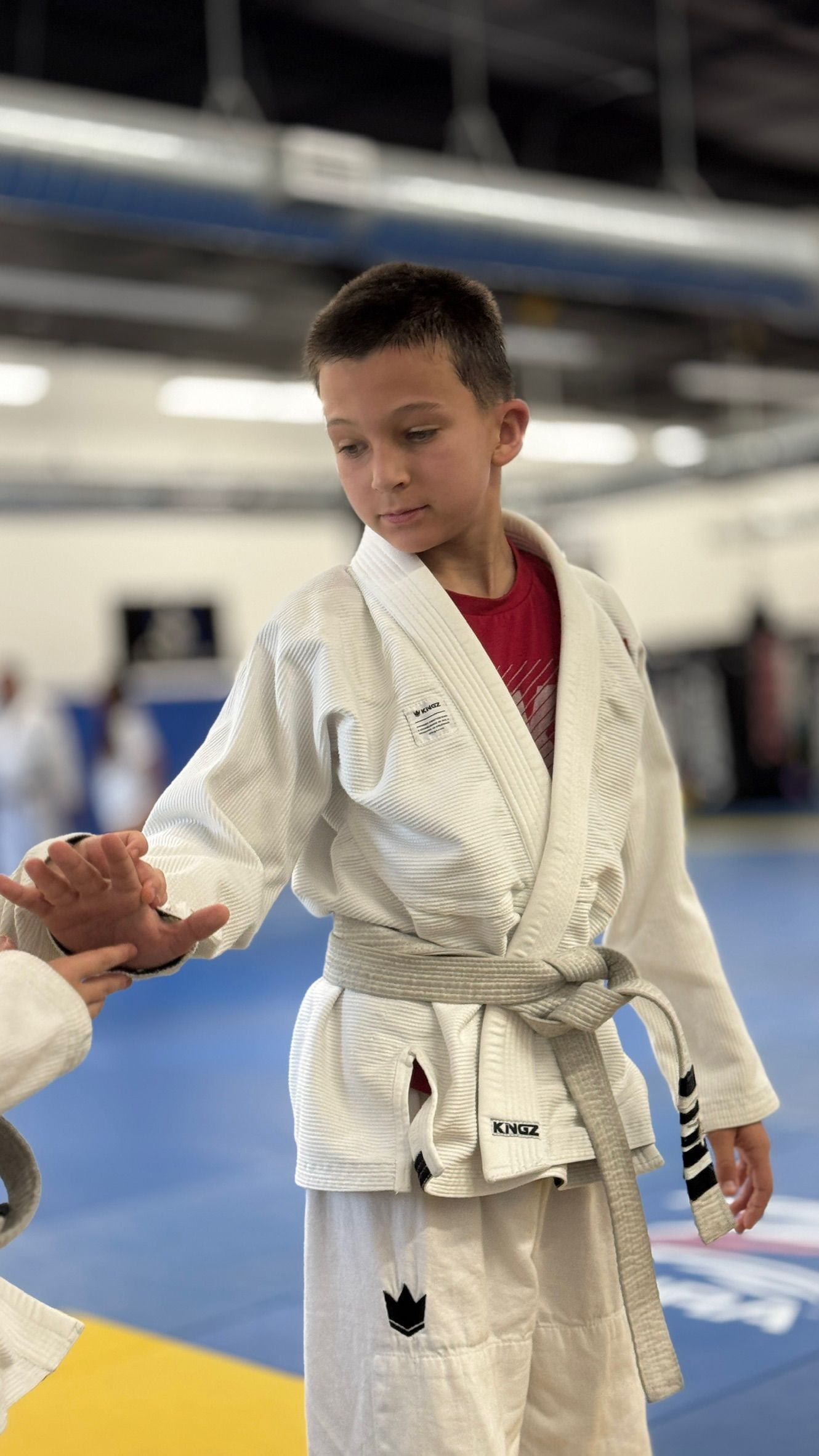
For kids and teens, this skill has a surprising benefit: it builds body awareness. That carries over into sports, playground confidence, and the ability to stay calm when something unexpected happens.
Skill 2: Posture and base (your anti-collapse system)
If we had to pick one concept that fixes dozens of beginner problems, it is posture. Good posture is not stiff. It is aligned, balanced, and ready to move. Base is the partner skill: how you place your weight and widen your support so you do not tip over like a chair on two legs.
When your posture is solid, it becomes harder for someone to break you down, pull you into submissions, or drag you into a position you do not understand yet. When your base is stable, your balance improves, and you stop wasting energy trying to stay upright.
This is why we teach posture and base early for Adult Brazilian Jiu-Jitsu in Orlando FL. Adults often show up with tight hips from sitting, old aches, or just normal day-to-day stiffness. We build posture and base in a way that respects that reality and still helps you get better quickly.
Skill 3: Frames (the difference between “stuck” and “structured”)
Frames are how you create space without trying to bench-press someone off you. Think of your forearms, shins, and hands forming strong lines that support your body and manage distance. You are not pushing explosively. You are building a structure.
If you can frame, you can breathe. If you can breathe, you can think. And if you can think, you can escape.
Beginners often try to do escapes with effort alone. Frames change that. They give you time, and time is everything on the ground. We also teach you when a frame is safe and when it is risky, because beginners sometimes frame with straight arms in ways that expose elbows and shoulders.
Skill 4: Escapes from the worst spots (because defense is confidence)
A beginner who can escape bad positions is a beginner who will keep training. That is not an exaggeration. If every round feels like getting pinned until time runs out, motivation drops fast.
Our early focus is on escaping the positions you will run into right away:
- Bottom mount: bridging, elbow positioning, and recovering guard
- Side control: frames, hip escape, and building to your knees
- Back control: hand fighting, head position, and safe turning choices
We teach escapes as a sequence, not a single move. You learn how to survive first, then how to create space, then how to recover position. This is also where Brazilian Jiu-Jitsu shines for self-defense: learning to escape pins and regain mobility is a realistic skill that does not rely on being bigger or stronger.
Skill 5: Hip movement (shrimping is only the beginning)
Hip movement is the engine that drives a lot of Brazilian Jiu-Jitsu. You will hear about shrimping early, but we do not stop there. We teach you how to move your hips for specific outcomes: create space, turn an angle, re-guard, or come up to a safer base.
A common Orlando-beginner pattern is tight hips and uncertain footwork on the mat. That is normal. We coach you through it with reps that are controlled and purposeful. Over time, your movement gets smoother, and you start feeling like you belong on the mat, not like you are slipping around on a moving sidewalk.
For Young Brazilian Jiu-Jitsu students, hip movement training also improves coordination and balance. Kids pick it up quickly, and once it clicks, you can see the confidence spike.
Skill 6: Grip fighting and hand placement (win the small battles)
Grip fighting sounds like an advanced topic until you realize it is happening all the time. Wherever your opponent’s hands go, problems follow: broken posture, pinned hips, flattened shoulders, and stalled escapes. So we teach you to notice grips early and respond with simple, repeatable answers.
This includes:
- How to clear a collar or sleeve grip without yanking
- How to protect your wrists and keep elbows in safe positions
- How to use inside position and head placement to reduce threats
- How to grip with purpose instead of grabbing whatever is near you
Grip fighting is also a big part of training safely. When you understand what hands are doing, you stop moving blindly into bad angles. That makes sparring more controlled and a lot less stressful.
Skill 7: Positional control (what “winning” looks like for a beginner)
New students often think Brazilian Jiu-Jitsu is mostly about submissions. Submissions are real, but the path to them is position. If you can control a position, you can slow things down, make better choices, and apply technique with less force.
We define positional control in beginner-friendly terms:
- You can hold the position without squeezing your lungs out
- You can adjust when your partner moves, instead of losing everything at once
- You can keep yourself safe from common reversals and escapes
For adults training Adult Brazilian Jiu-Jitsu in Orlando FL, positional control is also a fitness benefit. You learn how to use bodyweight efficiently. That is a different kind of strength than just trying harder, and it is more sustainable.
Skill 8: Basic guard retention (keep your legs between you and trouble)
Guard retention is the skill of keeping someone from passing your guard and settling into top control. For beginners, we keep this simple. Your first goal is not fancy inversions or complicated lapel systems. Your goal is to keep your knees and shins in front of your opponent, manage distance, and recover when they start moving around your legs.
We teach the core ideas:
- Inside position with your legs and knees
- Hip movement to follow the passer’s angle
- Framing with shins and forearms to stop forward pressure
- Recovering guard before you get flattened
This is one of those areas where a little improvement goes a long way. When your guard retention improves, sparring gets more fun because you are not restarting from a pin every 20 seconds.
Skill 9: Top pressure and balance (control without rushing)
Being on top can feel easier at first, but beginners still make predictable mistakes. The biggest one is trying to move too quickly and losing balance. Another is trying to hold someone down with brute strength instead of angles and weight placement.
We teach top pressure as a skill, not a personality trait. It includes:
- Where your hips should be to stay heavy without burning out
- How to keep your knees and feet active for balance
- How to progress from one control to the next without gaps
Top pressure also connects to self-defense fundamentals. If you can control someone on the ground and maintain balance, you are harder to disrupt and more capable of disengaging when you need to.
Skill 10: Composure under pressure (your secret weapon)
This might be the most practical beginner skill of all. When someone is on top of you, your body wants to panic. That is normal. Brazilian Jiu-Jitsu gives you a safe place to practice staying calm while your heart rate rises.
Composure is not just “be tough.” We teach simple tools:
1. Breathe through your nose when possible and exhale on effort
2. Use frames first, then move your hips, then recover position
3. Treat each round as problem-solving, not survival
4. Ask questions after class so confusion does not pile up
5. Stay consistent so your nervous system adapts and stress drops
This is one reason families love training. Kids learn to regulate emotions, and adults find that training stress makes daily stress feel more manageable. You still have responsibilities, traffic, work, all of it, but you handle pressure differently after a while.
What to expect in beginner classes in Orlando (and how we keep it safe)
Our beginner experience is structured on purpose. We do not throw you into the deep end on day one. You will learn how to move, how to partner safely, and how to train with control. That includes tapping early, respecting pace, and understanding what a good training round looks like.
A typical class flow is straightforward: a warmup that builds useful movement, a focused technique segment, and controlled drilling. When sparring is included, we scale it to your experience. Some days you might do positional rounds where you start in a specific spot, which is less chaotic and helps you build real skill faster.
For Young Brazilian Jiu-Jitsu students, we keep coaching clear and age-appropriate. We focus on listening skills, safe contact, and confidence that does not spill into recklessness. For adults, we keep instruction practical and repeatable, with plenty of time to ask questions and get coached through details that matter.
Take the Next Step
If you want a clear starting point for Brazilian Jiu-Jitsu in Orlando, our approach is simple: master the skills that keep you safe and in control first, then build offense on top of that foundation. When your posture, frames, escapes, and positional understanding improve, everything else starts to click, and training becomes something you look forward to instead of something you endure.
When you are ready, we would love to help you build those fundamentals step by step at
Tetris Jiu-Jitsu. Our programs are designed to support beginners, families, and busy adults with a safe training environment and a plan you can follow.
No experience needed to join Tetris Jiu-Jitsu and
learn step by step with structured coaching.